
You're Using AI Wrong (And It's Costing You)
Imagine you run a roofing company. You heard AI could help your business. So you signed up for ChatGPT. Maybe you got a chatbot widget on your website. You even tried automating a few emails.
Six months later, nothing really changed. Leads still fall through the cracks. Your phone still rings at the wrong times. You're still chasing estimates that never close.
Here's what I've learned building ClarityOS: most service businesses aren't missing AI tools. They're missing a proper AI workflow. That one distinction changes everything.
The Mistake Almost Every Service Business Makes
Most owners treat AI like a collection of apps. They stack tools. Chatbot here. Scheduling software there. A review request text that goes out randomly. Maybe an AI-generated email that sounds nothing like them.
It looks like automation. It isn't.
What they've actually built is a pile of disconnected software. Each tool does something. Nothing talks to anything else. The owner still has to bridge the gaps manually — which defeats the whole point.
I see this constantly in the home service space. HVAC companies using three separate platforms that don't sync. Plumbers with a booking bot that doesn't notify anyone when a lead comes in after hours. Cleaning companies paying for AI software they log into once a week.
The tools aren't the problem. The missing connective tissue is.
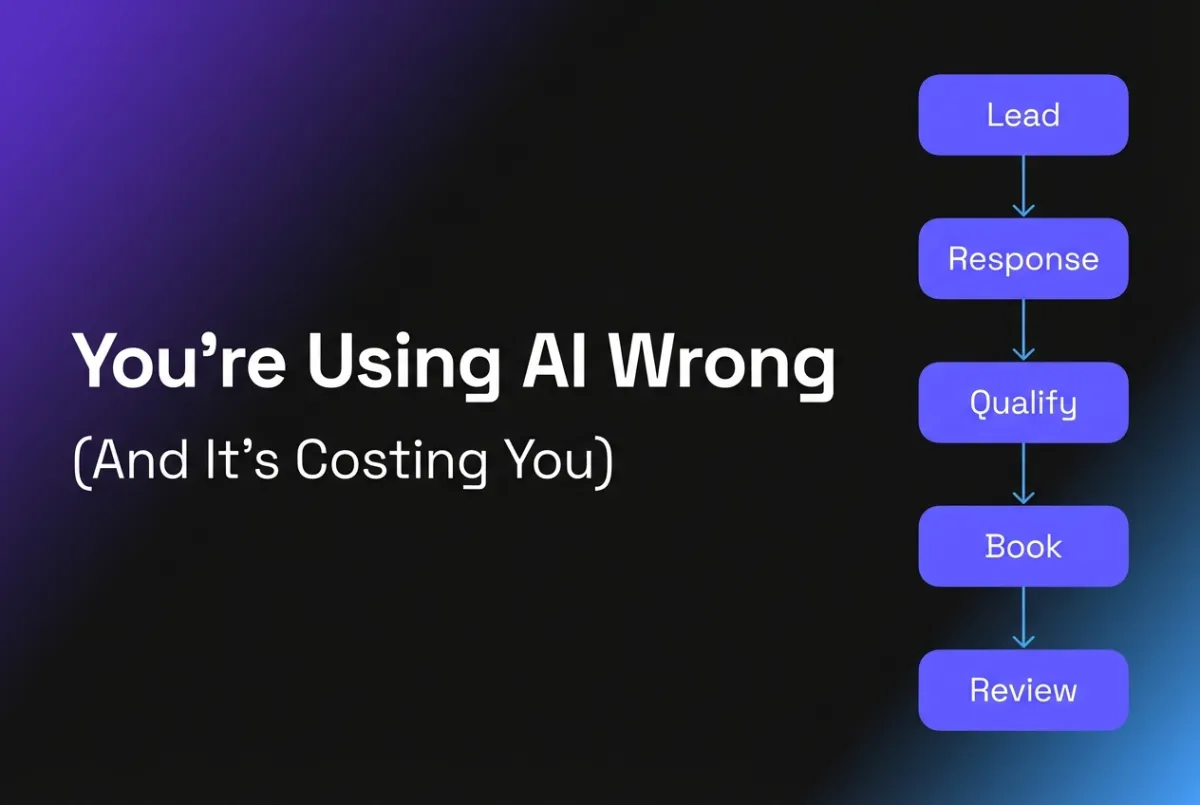
A real AI workflow isn't a stack of apps. It's a sequence. Lead comes in → lead gets responded to instantly → lead gets qualified → appointment gets booked → follow-up goes out automatically → review request fires after the job. Every step connected. Every handoff automatic.
That's what most businesses are missing. And the gap is expensive.
What That Gap Actually Costs You
Industry data from the Harvard Business Review found that companies responding to leads within one hour are seven times more likely to qualify that lead than those who wait even 60 minutes. For service businesses, most of that window closes before anyone on the team even sees the notification.
Think about what that means in real numbers. If your business generates 40 leads a month and you're closing at 30% — that's 12 jobs. If slow or broken follow-up drops your close rate to 20%, you just lost four jobs. At a $600 average ticket, that's $2,400 gone. Every month. Not because of bad marketing. Because of a broken AI workflow.
I wrote about this in more detail in The 4 Revenue Leaks Costing Home Service Businesses $3,000–$12,000 Per Month. The numbers are uncomfortable. But they're real, and most owners don't know they're bleeding.
The painful part? The tools to fix this already exist. They're not expensive. They're not complicated. The gap isn't technology. It's strategy.
What a Real AI Workflow Actually Looks Like
A functioning AI workflow for a local service business has a few non-negotiables.
First, it starts at the point of contact. The moment a lead comes in — whether through your website, Google, Facebook, or a missed call — something has to happen immediately. An automated text. A voicemail response. A chatbot that qualifies intent. Most people get this backwards. They build the middle of the workflow before building the front door.
Second, every step has a trigger. Nothing happens because someone remembered to do it. A lead filling out a form triggers a text. That text response triggers a qualification sequence. A booked appointment triggers a confirmation and a reminder. You're not hoping someone on your team catches it. The system catches it.
Third, it closes the loop after the job. This is where almost everyone stops too early. The job gets done. The invoice goes out. That's it. A complete AI workflow sends a review request 24 hours after completion. It checks in with the customer at 30 days. It re-engages them before the next seasonal service window. One closed job becomes a long-term customer relationship — automatically.
If you want to see how this applies specifically to HVAC, I broke it down in How HVAC Companies Use AI to Stop Missing Calls and Win More Jobs. The framework translates directly to plumbing, roofing, electrical, and cleaning.
Why Most AI Advice Makes This Worse
Here's the thing nobody tells you: most AI content online is written for tech companies, marketing agencies, or enterprise software teams. It assumes you have a dedicated ops person. It assumes you understand API integrations. It assumes you have time to experiment.
You don't. You're running a service business. You're managing crews, chasing parts, handling customer calls, and trying to grow at the same time.
The advice you usually find tells you to "leverage AI to optimize your customer journey." That sentence means nothing when you're dispatching three techs before 8am.
What actually helps is specificity. Knowing exactly which tool handles which step. Knowing what triggers what. Knowing which part of your workflow to fix first because it's bleeding the most money right now.
That's what I built ClarityOS to do. Not to sell software. Not to run ads. To help service businesses understand where their workflow is broken and build something that actually runs.
What is ClarityOS? — if you want the full picture of what we do and why we built it this way.
Most service businesses aren't losing to competitors with better services. They're losing to competitors with better systems. An AI workflow isn't a luxury. At this point, it's the baseline.
If you're not sure where your workflow is breaking down, let's find it. Book your free AI Tools Audit at https://www.theclarityos.com/discovery and we'll map exactly where you're leaking time and money — and what to do about it.