Your Business Runs on 7 Different Apps. What If They All Talked to Each Other?
Most small business owners are running their company across 7, 8, sometimes 10 different tools.
QuickBooks for accounting. A separate CRM for leads. Scheduling software that doesn't talk to anything else. A spreadsheet for tracking jobs. Another tool for payroll. Text messages for team communication. And a gut feeling for everything else.
Every one of those tools holds a piece of your business. But none of them tell you the whole story.
That's not a technology problem. That's a visibility problem. And it's costing you more than you think.
The Hidden Cost of Disconnected Business Software
Here's the thing nobody talks about: the biggest drain on your time isn't the work itself. It's the mental load of pulling information from a dozen different places just to answer a simple question like, *"How are we doing this week?"*
You open QuickBooks. Then your CRM. Then your scheduling app. Then maybe a spreadsheet you built three years ago that nobody else understands. You piece it together. You make a decision. You move on.
And then you do it again tomorrow.
Business owners running disconnected software systems lose an average of 5–10 hours per week just in reporting, status checks, and manual data reconciliation. That's not downtime. That's your most valuable hours — wasted on information gathering instead of decision-making.
The real cost? Slower decisions. Missed patterns. Revenue leaks you can't see because the data that would reveal them lives in four different platforms.
What a Custom Business Command Center Actually Does
We're building something different for service-based businesses.
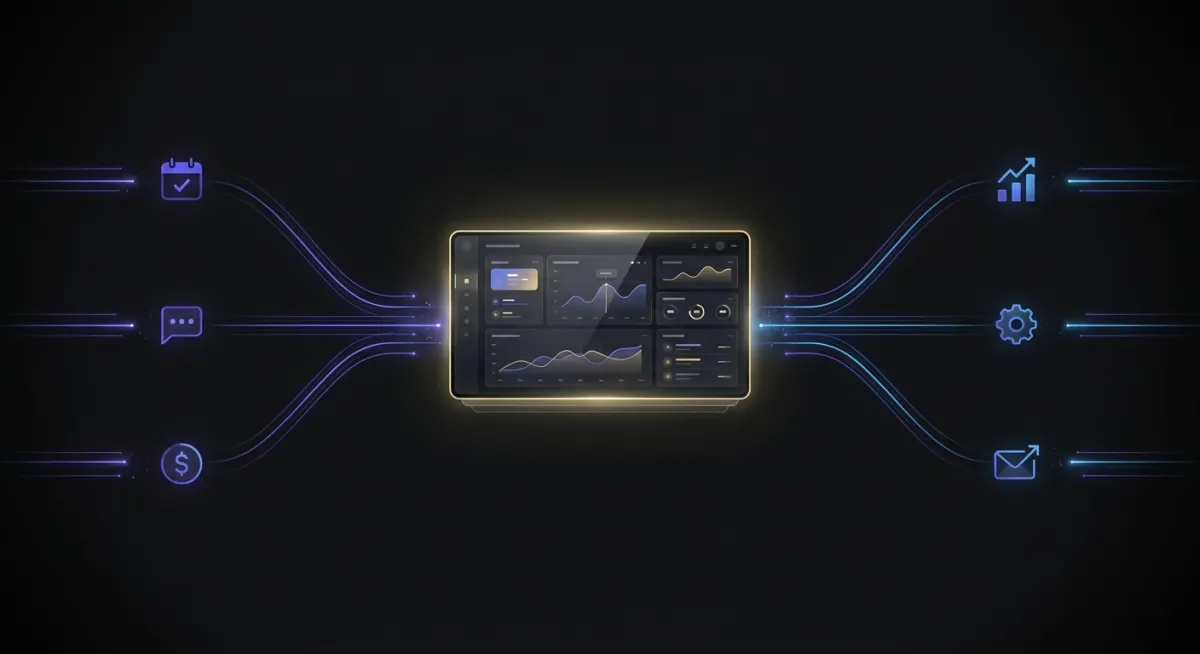
A custom business command center is a single, centralized interface — built specifically for how *your* company operates — that pulls live data from all of your major tools into one dashboard. One login. One screen. Everything.
Here's what that looks like in practice:
Your CRM and sales pipeline — how many leads came in, where they are, who needs follow-up
Your job board and scheduling software — what's booked, what's in progress, what's delayed
Your financials — revenue collected, invoices outstanding, job profitability
Your team performance — response times, job completion rates, technician productivity
Your reputation and reviews — Google rating, new reviews, review velocity
Your marketing metrics — ad spend, leads generated, cost per acquisition
All of it. One screen. Updated in real time.
No logging into five platforms. No building a manual report. No guessing. Just clarity.
This Isn't Off-the-Shelf Software. It's Built for Your Business.
There's a reason most business owners don't have this yet.
Generic software tries to work for every business. It's built for the average. And if your company is anything other than perfectly average — if you have a specific way you track jobs, a unique pricing structure, a custom workflow your team has built over years — generic software fights you at every step.
A custom business dashboard is different. It's designed around the way *you* run your business.
That means:
Your metrics, not theirs. We build the KPIs that matter to you — not a template full of numbers you'll never look at.
Your systems, connected. We integrate the tools you already use. No ripping and replacing. No forcing your team to learn something new. We connect what's already working.
Your language. The dashboard speaks in the terms your business uses — your job stages, your team structure, your revenue categories.
The result is a business intelligence dashboard that feels like it was made for you. Because it was.
The Reporting Problem Most Businesses Don't Know How to Solve
Here's a question worth sitting with:
Do you have a single place you can look — right now, today — and see the full health of your business?
If the answer is no, you're operating on incomplete information. And incomplete information leads to slow decisions, missed opportunities, and a business that always feels harder to manage than it should.
The reason most businesses struggle with reporting isn't a lack of data. It's the opposite. You have too much data, spread across too many systems, with no clean way to pull it together.
Business reporting software used to require an IT department, a six-figure implementation budget, and months of setup. That world is gone.
Because of AI, we can now build custom integrations between your existing tools in a fraction of the time and cost it would have taken just two years ago. What used to require a full development team can now be built and deployed in weeks.
The barrier to having a real business KPI dashboard — one that's custom to your operation — has never been lower.
Why Now Is the Right Time
We're in an accelerating window.
AI isn't just changing what businesses can automate. It's changing the speed and cost at which custom software solutions can be built and maintained.
Tools that used to cost $50,000 to custom-build can now be deployed for a fraction of that. Integrations between platforms that once took months can be wired in days. Dashboards that previously required a dedicated data engineer can now be built and managed by a small team with the right AI-assisted development tools.
That means one thing for small business owners: the level of operational visibility that only large companies could afford is now accessible to you.
If you run an HVAC company, a plumbing operation, a roofing company, a cleaning service, or any other service-based business — the custom business command center that could transform how you operate is no longer out of reach.
The businesses that move first will have a structural advantage. Their owners will spend less time chasing information and more time acting on it. Their teams will have clearer direction. Their decisions will be faster and better-informed.
The businesses that wait will keep logging into seven apps and piecing together the story manually.
What the Process Looks Like
We start with a simple conversation.
A ClarityOS advisor maps out your current systems — what tools you're using, how data flows (or doesn't flow) between them, and where the gaps are costing you time and visibility.
From there, we build a custom roadmap for your command center: which integrations to prioritize, what your KPI dashboard should show, and how the interface should be structured to match the way your team actually works.
Then we build it.
You don't need to become technical. You don't need to manage a development project. You describe how your business works. We build the system that reflects it.
One Dashboard. Total Clarity.
You should be able to wake up every morning, open one screen, and know exactly where your business stands.
Revenue collected. Jobs in progress. Leads in your pipeline. Reviews coming in. Team performance. All of it — at a glance, in real time, built for the way your company runs.
That level of clarity isn't a luxury. It's what good operations look like. And in 2026, it's more achievable than it's ever been.
Schedule a free strategy call with a ClarityOS advisor. We'll map out your current systems, identify where your visibility gaps are, and give you a clear roadmap for building your custom business command center.
There's no pitch. No pressure. Just a conversation about how your business runs — and what it would look like to see all of it clearly, in one place.
Book your free strategy call at https://www.theclarityos.com/discovery
Related Reading: