
AI for Home Service Businesses: What It Actually Does (And What It Doesn't)
Most contractors think AI is built for tech companies.
Meanwhile, their competitors are using it to respond to leads in 60 seconds, automatically send review requests the moment a job closes, and follow up with every quote they've sent — without lifting a finger.
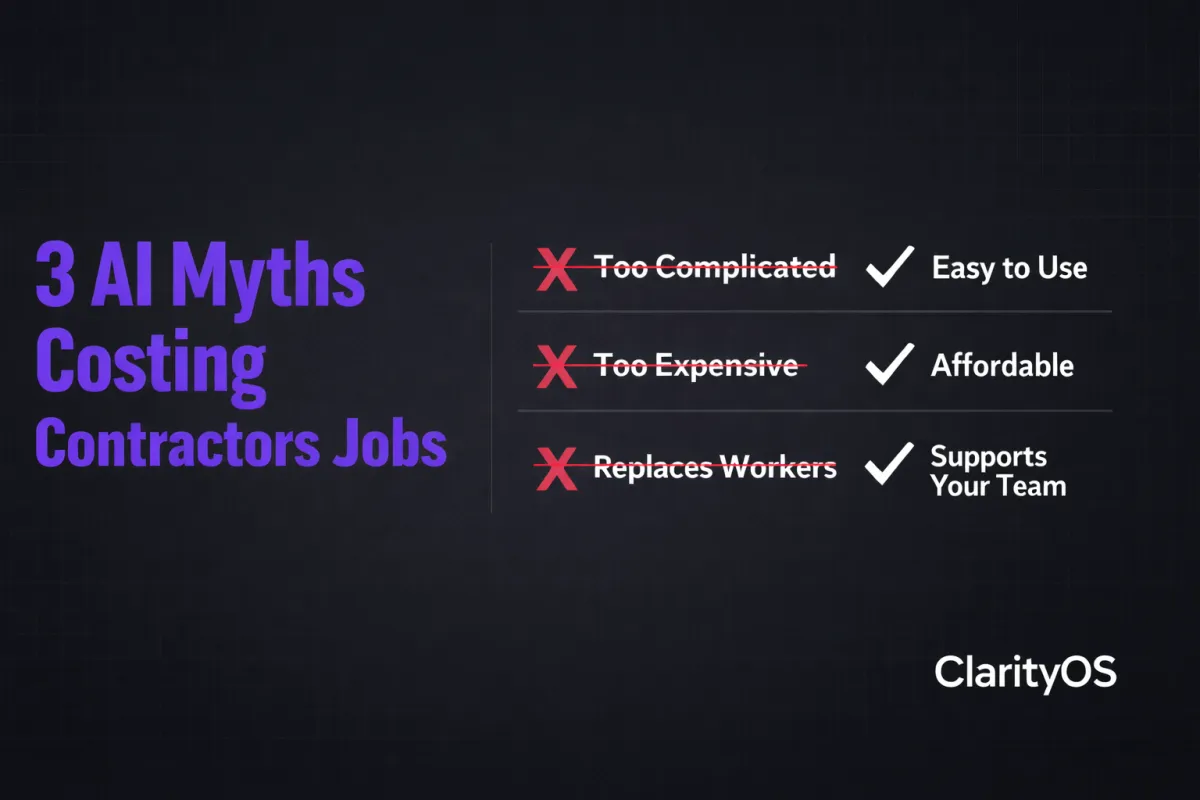
The three myths blocking most service business owners from this? They're all wrong. Let's go through them.
Myth #1: "AI Is Too Complicated for My Business"
Here's the irony: AI automation was built for exactly what you do.
Think about what running a service business actually looks like. Booking appointments. Following up with leads. Answering the same five customer questions over and over. Sending invoices. Chasing down Google reviews. Every one of those is a repetitive, rule-based task.
Repetitive and rule-based is exactly where AI automation thrives.
When I built the follow-up system inside ClarityOS, the most common pattern I saw was this: a prospect calls after hours, doesn't leave a voicemail, and never hears back. A missed call automator changes that in one afternoon. Text goes out within 60 seconds. "Hey, I just missed your call — what can I help you with?"
No robotics. No machine learning degree. A simple workflow that runs in the background while you're on the job.
The contractors who feel like AI is "too complicated" are usually picturing the complicated stuff — custom software, AI models, machine learning pipelines. That's not what your business needs. You need the simple stuff: automated texts, scheduled follow-ups, smart workflows that replace the tasks you're currently doing manually.
Simple stuff is exactly where AI automation wins.
Myth #2: "AI Is Too Expensive for a Business My Size"
This one has the math completely backwards.
The question isn't what AI costs. It's what *not having it* costs.
An HVAC company getting 40 inquiries a month, responding to 30, and closing 50% of those closes 15 jobs. What happens to the other 10 inquiries — the missed calls, the unanswered form submissions, the leads who texted after hours and got no response? Those are jobs that went to whoever responded first.
If the average HVAC job is $1,200, that's potentially $12,000 a month in revenue walking out the door — not because the competitor is better, but because they were faster.
The AI automation that stops that bleed? Less than $500 a month.
The math isn't difficult. The cost of not automating is usually 10 to 20 times the cost of the tool. The conversation isn't "can I afford AI?" It's "how much longer can I afford to operate without it?"
Myth #3: "AI Will Replace My Team"
If your biggest fear about AI is that it'll replace your people, here's a question worth sitting with: what are your people doing that you're worried AI would replace?
AI doesn't replace your best HVAC technician. It doesn't replace your project manager or your client relationships. It replaces the part of your office manager's day where she's manually copying lead information from one spreadsheet into another. It replaces the version of you that's sending follow-up emails at 9 PM on a Thursday.
The businesses winning with AI right now aren't cutting headcount. They're redirecting their team's time from administrative tasks to work that actually requires judgment, relationships, and expertise.
The goal isn't fewer people. It's better-used people.
What AI Actually Does for Service Businesses Right Now
Here's the concrete short list of what AI automation is doing in real service businesses today:
Missed call recovery. Prospect calls outside business hours → automated text within 60 seconds → job booked before your competitor even knows there was an inquiry.
Lead nurture sequences. Someone submits a quote request → automated follow-up over 5 days (text, then email, then text) → no manual chasing required.
Review solicitation. Job marked complete in your system → automated text to the customer with a direct Google Review link → reviews start coming in without asking.
Appointment reminders. Job booked → automated reminder 24 hours out → no-show rate drops without a single phone call.
After-hours customer responses. Prospect DMs your Facebook page at 10 PM asking about pricing → AI sends your standard response instantly → you follow up in the morning with a warm lead ready to book.
None of these require a programmer. None of these take months to configure. The businesses building this infrastructure now will look like they have a much bigger operation than they do. Because they effectively will.
Where to Start
If you've been sitting on the fence about AI because it felt complicated, irrelevant to your trade, or like something other businesses do — start with one thing: missed call recovery.
Set up an automated text response for any call you miss. It takes a few hours to configure the first time. Then it runs on its own forever.
From there, the questions get more specific: Which part of your business eats the most time? What task do you personally dread every week? That's your next automation.
If you want a complete picture of where your business is leaking time and revenue — and which specific AI tools apply to your trade — that's exactly what the AI Revenue Leak Diagnosis covers. Sixty minutes. Your specific business. A custom prescription of what to automate and in what order.
Ready to find out where your business is leaking time and money? Book your free AI Revenue Leak Diagnosis at https://www.theclarityos.com/discovery